You have seen those cold minimalist bathrooms. Let is fix that.
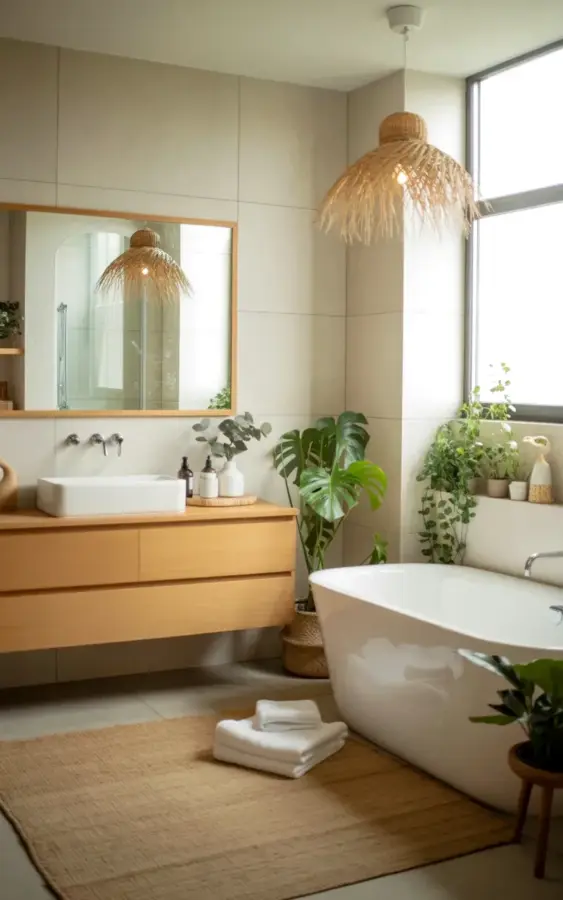
Honestly, I used to think a minimalist bathroom meant white subway tiles, a floating shelf, and zero personality. That look is fine if you are running a lab. But for a home? It feels like a fridge with a toilet. Then I stumbled onto the real deal: a warm minimalist bathroom with plants. That photo above? The freestanding oval tub, the light wood vanity, those woven rattan pendants, the beige tiles, and that monster monstera in the corner. It changed everything. So I started paying attention to the mistakes people make when they try this style. And I made most of them myself. Here is what I learned.
Mistake 1: Picking the wrong tile. White is not the only option.
Everyone says go with white because it feels clean. Look, white tile is clean. It is also sterile. It bounces light in a harsh way, and if your grout is not perfectly white, it looks dirty within a week. The photo above uses large format beige tiles. They read as warm, almost sandy. They hide dust and water spots way better than white. And they do not scream “hospital bathroom.”
Here is the thing: warm beige or very light greige tiles give you that clean minimalist look without the iciness. Go for matte finish, not glossy. Glossy beige can look cheap, matte looks like stone. Spend the extra money on large tiles (24×48 or bigger) because fewer grout lines means less visual noise. That is the whole point of minimalism, right?
- Tile choice rule: If you would not want to touch it with your bare foot, do not buy it. Matte beige = cozy. Glossy white = cold.
- Second rule: Grout color should be slightly darker than the tile. White grout on beige tile looks like bad dental work. Go with a sand or warm gray grout.
- Third rule (yes, three is a lot, but this matters): Run a floor sample under water. See if it slips. Beige porcelain in a matte finish usually grips well. White polished ceramic is basically an ice rink.
I once spent two months agonizing over tile samples. My husband thought I was crazy. Then he walked into the bathroom and said “oh, it feels like a spa.” That is the power of the right beige. Not the wrong one.
Mistake 2: Ignoring natural textures in fixtures and lighting
You can have the warmest tile in the world, but if your vanity is white high-gloss and your lights are chrome, it will still feel mechanical. The photo nails it: a light wood floating vanity with two drawers. Not dark walnut, not painted white. A pale oak or birch tone. It matches the floor? No, it matches the warmth. And those woven rattan pendant lights are not just decoration. They scatter the light, soften it, throw shadows that feel like a late afternoon in Bali.
Look, I am not saying you need to go full bamboo everything. But one or two pieces of natural texture change the whole vibe. A light wood vanity. A bamboo stool. A linen shower curtain. Even a small woven basket for towels. The mistake people make is buying a mass-produced “modern” vanity from a big box store that is actually particle board with a fake wood print. That is not natural texture. That is natural pretending.
Get real wood. Or at least a good veneer. The rattan pendants? You can find them on Etsy for under $80 each. They add warmth, they hide the bare bulb glare, and they make the room feel lived in. I have three in my bathroom now. One of them constantly catches dust, and I have to vacuum it with a brush attachment. That is annoying. But it beats staring at a cold downlight.
Mistake 3: Leaving plants out because “bathrooms are too dark”
This is the biggest regret I hear from friends. They think a bathroom with no window cannot support plants. Or they buy a fake fern that collects dust and looks sad after two months. Look at that photo: a massive monstera, plus a smaller plant on the vanity, plus something trailing from the window sill. They are real. They are thriving. And they make the bathroom feel alive in a way no candle ever can.
Here is the truth: bathrooms are actually perfect for many plants because of humidity. Monstera, pothos, snake plants, and ferns all love steamy showers. The mistake is choosing a plant that needs direct sunlight. Your typical bathroom window is east or north facing. That is fine for a monstera or a ZZ plant. Put it near the window, not in the corner. If you have no window at all, get a snake plant or a pothos and use a grow light bulb in one of your vanity fixtures. I use a cheap GE grow bulb in a pendant light. It looks normal. The plant grows. Nobody knows.
- Monstera deliciosa: for that big, dramatic leaf. Needs indirect light. Wipe the leaves with a damp cloth every two weeks or they get dusty. Yes, I actually do this. It takes three minutes and feels meditative.
- Pothos: virtually unkillable. Trailing or on a shelf. Bright green or variegated. It will survive even if you forget to water it for a week.
- Snake plant: for the dark corners. Does not need much humidity, but it tolerates it. Easiest plant alive. I have killed cacti but never a snake plant.
Mistake 4: Cluttering the counter. You need a clear surface.
Ok so the photo shows a perfectly clean vanity top. No toothbrush holder, no soap dispenser, nothing. That is the ideal. But real life? You have toothpaste, a hairbrush, a phone stand, a candle, and seven bottles of lotion you do not even use. The mistake is trying to store everything out in the open because you think a closed cabinet is out of sight out of mind. But then it is out of sight and you forget you have it, so you buy another bottle. Wasteful.
Instead, use the drawers. Floating vanities with two deep drawers (like the one in the photo) can hold your daily essentials. Leave only one small tray on the counter for the thing you use every single time: hand soap or a single small plant. Train yourself to put things away. It takes ten seconds. I am not perfect at this either. Honestly, I leave my glasses on the counter all the time. But for the photo? I stashed them in the drawer. The point is, clear surfaces make a minimalist bathroom look intentional, not abandoned.
A quick tip that changed my life: get a magnetic strip inside the vanity door for tweezers and scissors. And a small caddy for the shower caddy that matches your wood tone. No plastic.
Mistake 5: Forgetting the bathtub is the hero of the room
In that photo, the freestanding white oval tub is the star. It is placed against the wall, not floating in the middle, which saves space. But the mistake I see is people treat the tub as just a functional object. They pick a cheap acrylic model that looks like a giant plastic laundry basket. Or they choose a dark colored tub that absorbs all the light and makes the room feel smaller.
White matte oval tubs are classic for a reason. They reflect light, they feel timeless, and they do not fight with the rest of the materials. Place it so you have room to walk around it. In smaller bathrooms, push it against the wall like the photo, but leave a few inches gap for cleaning. Trust me, you do not want mold growing behind a tub you cannot reach. That is a specific nightmare I had in an old apartment. Never again.
If you cannot fit a freestanding tub, you can still get a warm minimalist feel with a built-in tub and a wood surround. Same idea: light wood, simple lines, no 80s jets. A deep soaking tub matters more than shape. I would rather have a standard rectangular tub that is deep than a fancy oval that is shallow. You can sit in deep water. You cannot sit in shallow oval, you just lie there like a sad sardine.
Mistake 6: Underestimating the power of the mirror and natural light
Look at that mirror in the photo. Large rectangle, thin wooden frame. It reflects the window light, bounces it around the room, and makes the beige tiles glow. The mistake is using a mirror that is too small or frameless. A small mirror makes the room feel cramped. A frameless mirror looks fine but adds no warmth. The wood frame ties into the vanity and the pendants. It is a subtle connector.
Natural light streaming in from a window is your best friend. But if you do not have a window, fake it with a large mirror opposite the door. Angle the mirror so it catches the light from the hallway or a skylight. You can also install warm LED strips behind the mirror or under the vanity. 2700 Kelvin, not 4000. Cool white LED in a warm minimalist bathroom is like wearing a parka to a beach party. Just wrong.
And please, please do not hang a mirror that is smaller than the vanity. Go bigger. I once saw a mirror that was 18 inches wide above a 36 inch vanity. It looked like a postage stamp. The proportions were so off I had to say something. The homeowner got defensive. “I like the shape.” I like tacos but I do not put them in a bathroom. Big mirrors, warm light, wood frame. That is the formula.
The takeaway: Warm minimalism is about subtraction, not coldness
You do not need a ton of stuff to make a bathroom feel inviting. You need the right stuff. Warm beige tiles, light wood, woven textures, real plants, clear surfaces, a tub that invites a soak, and a mirror that opens up the light. The mistakes are all about trying to copy a minimalistic look without considering how it feels to be inside the room. A warm minimalist bathroom with plants is not just a design choice. It is a mood. It is the room where you take off the day. So go ahead, swap out that chrome pendant for a rattan one. Buy a monstera. Wipe its leaves every two weeks. And if you mess up the tile grout, I will not tell anyone. Pin this article for later, and next time you plan a bathroom redo, think of that photo and those beige tiles. They work. Trust me on this one.
#minimalistbathroom #bathroomdesign #naturaltextures #indoorplants #housedecor
Leave a Comment