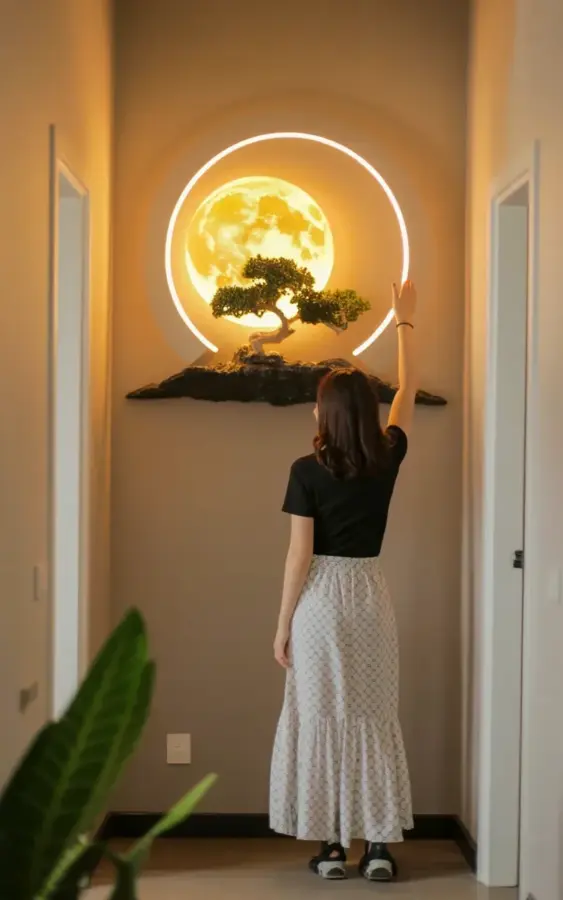
She reaches up on her toes, fingers stretching toward the glowing circle of light. The full moon wall art is mounted just high enough that she can’t quite touch the smooth surface. That photo is a perfect example of the most common fullmoonwallart mistake I see in homes. The piece is stunning, the soft golden glow of the moon with the dark bonsai silhouette beneath it, but the placement is throwing the whole hallway off balance.
Hallway decor has a particular problem. It’s a transitional space, so people tend to treat it as an afterthought. They hang things too high, they hang things too small, or they just leave the walls completely bare. A piece like this, with a moon and bonsai combined, deserves better than a guess. Let’s talk about why that height matters, what this specific style of art needs, and how to fix it in your own home.
## The Height Mistake That Kills a Hallway Vignette
The woman in that photo is stretching. Her arm is extended, her body is leaning slightly forward, and the moon is sitting somewhere around seven feet off the ground. That’s too high. When you have to reach up to touch a piece of wall art, you’ve created a disconnect between the viewer and the artwork.
The standard rule of thumb for wall art height is simple. The center of the piece should sit at roughly eye level, which is about 57 to 60 inches from the floor. But here’s the thing: that rule assumes an average standing adult. Hallways are often viewed from a standing position, but they’re also walked through, glanced at from an angle, and seen from the adjacent rooms. If the center of your full moon wall art is above your eye line, it starts to feel like a skylight instead of a piece of decor. You want the moon to feel present, not like it’s floating away from you.
## Why This Moon and Bonsai Wall Art Works in Theory
There’s so much to love about this particular piece. The golden yellow moon is large and fully illuminated, and the white circular LED ring around it gives the whole thing a halo effect. That’s a dramatic look. It’s inherently warm, inviting, and a little bit mystical. The bonsai tree at the base, with its dark green foliage and black rocky terrain, anchors the piece in something more grounded and natural.
That contrast is what makes the moon and bonsai combination so special. You have the celestial above and the terrestrial below, a meeting of sky and earth. It’s a deeply calming design concept. I’ve seen similar pieces used in meditation rooms and modern minimalist living rooms, but hallways are an underrated canvas for this aesthetic. A narrow corridor gives the art a chance to command your attention without competing with furniture, television screens, or a busy fireplace mantel.
But here’s the catch. A piece with that much going on needs to be positioned like a focal point, not a random decoration. If you mount it too high, you lose the bonsai wall art detail entirely. The rocky terrain and the fine branches of the tree get lost because your eye is drawn straight to the moon. The ground at the base of the piece is where the story begins, and you need to be able to read that story at a natural glance.
## How to Get the Height Right (Without a Measuring Tape)
If you don’t have a tape measure handy, there’s a practical trick you can use. Stand in front of the spot where you plan to hang the piece and let your arms hang naturally at your sides. If the center of the full moon wall art is level with your wrist or your elbow, you’re in a good range. If you have to raise your arm, bend your elbow, or look up, it’s mounted too high.
Now, I know some of you are thinking, but what about staircases or tall ceilings? Look, those are different situations. A two-story hallway or a staircase wall gives you permission to hang art higher because the viewing angle is different. But for a typical single-story hallway, like the one in that photo with the beige wall and white doorways, keep it low. Keep it accessible. The goal is to make the art feel like it belongs at your level, sharing your space.
– The center of the piece should be around 57 to 60 inches from the floor for most hallways.
– If a piece has a lower visual anchor, like a bonsai tree, the whole artwork should sit slightly lower than the standard rule.
– Test the height by standing back and taking a photo with your phone, then review it. Your camera captures the eye-level perspective more honestly than your own peripheral vision.
– Don’t center it exactly between the floor and ceiling. Center it where your gaze naturally rests when you enter the hallway.
## Hallway Decor That Doesn’t Shout
Hallways are tricky because they’re narrow. A piece that’s too large can feel claustrophobic, but a piece that’s too small disappears. This full moon wall art with the bonsai and the LED ring finds a sweet spot. It’s substantial without being overwhelming. The LED ring adds a subtle glow that actually illuminates a small portion of the wall, which is useful in a hallway that might not have great natural light. And honestly, a softly glowing moon is a much better nightlight than a harsh sconce.
But your hallway decor shouldn’t rely on one piece alone. Think about the surrounding elements. That beige wall and the white door frames in the photo create a quiet, neutral backdrop. The woman’s outfit, casual black t-shirt and a flowing white patterned maxi skirt, adds a relaxed human energy to the space. That’s the feeling you want. The art should feel like a natural extension of the people who live there, not a museum exhibit mounted on a wall. A small console table or a simple floor plant at the base of the artwork could create a beautiful little vignette. And if you’re going to do that, you absolutely have to lower the art. A piece hanging six feet up above a low console table looks completely unhinged.
## The Bonsai Wall Art Problem Nobody Talks About
Let’s talk about the elephant in the room. Bonsai lovers are a particular breed. We obsess over pruning schedules, wire training, and the precise angle of a trunk. So looking at a bonsai wall art piece, where the tree is frozen in time and can never grow, might feel a little strange at first. But after living with a piece like this, I’ve come to appreciate it differently. It doesn’t replace a living bonsai. It honors the form and the spirit of one.
That black rocky terrain and the dark green foliage create a high-contrast base. Against a beige wall, those dark tones are going to pop. Just be mindful of your surrounding lighting. A hallway with dim lighting will swallow the dark parts of this piece, leaving you with only the moon floating in space. That’s not a good look. You want the LED ring to have company. Adding a small picture light directed at the base can balance the glow and make sure the bonsai silhouette stays visible. And while you’re at it, check your hallway’s other light sources. That warm golden moon will clash with cool white or blue-toned lighting, so switch to warm bulbs elsewhere in the hall to keep the mood cohesive.
## A Few Final Thoughts on Placement and Flow
I should mention that the wall itself matters just as much as the height. The photo shows the piece between two white doorways, which is a fantastic location if you get the placement right. The symmetry of the door frames gives the artwork a built-in frame. But if you’re hanging it in a spot where people are constantly brushing past, the protruding surface of a deep frame can get knocked off balance. Honesty, a slim frame that sits close to the wall is safer for a busy hallway. And I’ve learned this the hard way, don’t use cheap adhesive strips for anything heavier than a lightweight poster. This piece, with the LED ring and the solid backing, needs a proper wall anchor. You don’t want to wake up to the sound of a crashing moon in the middle of the night.
For seasonal decor, this piece is perfect for autumn and winter. The warm golden yellow moon fits perfectly with the cozy, hygge vibe that everyone leans into when the days get shorter. It’s also a nice way to balance out the typical fall leaves and pumpkins that dominate the season. In the spring and summer, the bonsai element brings a natural, grounded feel that compliments the greenery outside. It’s the kind of piece that genuinely works year-round, which is rare for a statement item like this.
The takeaway is straightforward. Pay attention to your eye line. That full moon wall art is at its best when it’s at your level, inviting you to stop and look, not trying to escape into the ceiling. And don’t forget to take a step back and look at the whole picture. The hallway is a passage, but it’s also a destination in its own right. Treat it like one.
So, where would you hang yours? Maybe in a narrow hallway like the one in the photo, or perhaps over a reading nook where the warm glow can add some atmosphere. Just measure twice, hang once, and keep it low enough to touch. And if you get it right, you’ll pass by that moon and bonsai every day and feel a little calmer every single time.
Leave a Comment